

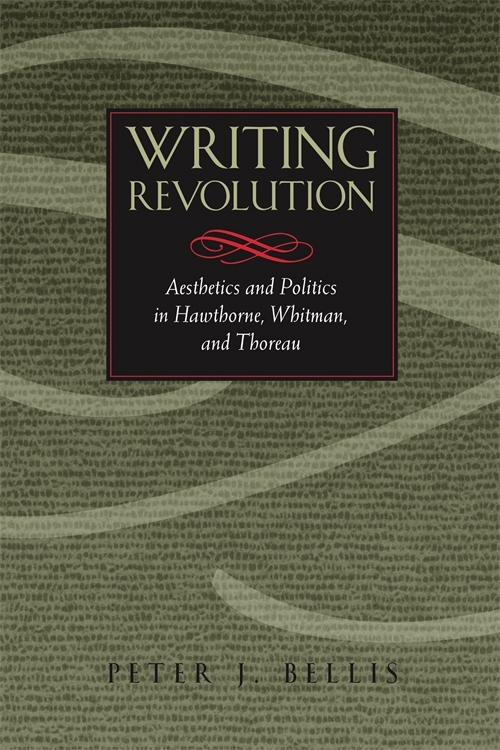
Writing Revolution
Aesthetics and Politics in Hawthorne, Whitman, and Thoreau
Title Details
Pages: 232
Trim size: 6.000in x 9.000in
Formats
Paperback
Pub Date: 04/15/2010
ISBN: 9-780-8203-3461-5
List Price: $29.95
Related Subjects
Writing Revolution
Aesthetics and Politics in Hawthorne, Whitman, and Thoreau
Skip to
- Description
- Reviews
In recent years, formalist and deconstructive approaches to literary studies have been under attack, charged by critics with isolating texts as distinctive aesthetic or linguistic objects, separate from their social and historical contexts. Historicist and cultural approaches have often responded by simply reversing the picture, reducing texts to no more than superstructural effects of historical or ideological forces. In Writing Revolution, Peter J. Bellis explores the ways in which literature can engage with—rather than escape from or obscure—social and political issues.
Bellis argues that a number of nineteenth-century American writers, including Nathaniel Hawthorne, Henry David Thoreau, and Walt Whitman, saw their texts as spaces where alternative social and cultural possibilities could be suggested and explored. All writing in the same historical moment, Bellis's subjects were responding to the same cluster of issues: the need to redefine American identity after the Revolution, the problem of race slavery, and the growing industrialization of American society.
Hawthorne, Bellis contends, sees the romance as "neutral territory" where the Imaginary and the Actual—the aesthetic and the historical—can interpenetrate and address crucial issues of class, race, and technological modernity. Whitman conceives of Leaves of Grass as a transformative democratic space where all forms of meditation, both political and literary, are swept away. Thoreau oscillates between these two approaches. Walden, like the romance, aims to fashion a mediating space between nature and society. His abolitionist essays, however, shift sharply away from both linguistic representation and the political, toward an apocalyptic cleansing violence.
In addition to covering selected works by Hawthorne, Whitman, and Thoreau, Bellis also examines powerful works of social and political critique by Louisa May Alcott and Margaret Fuller. With its suggestions for new ways of reading antebellum American writing, Writing Revolution breaks through the thickets of contemporary literary discourse and will spark debate in the literary community.
Bellis is deeply at home in the texts he discusses. When he dives in, he brings back long-buried treasure.
—Philip F. Gura, University of North Carolina at Chapel Hill
Bellis has a compelling subject, aesthetics and politics, and a fascinating selection of writers, Hawthorne, Whitman, and Thoreau. The book is well written and well researched; discussions of the individual writers are smart and rich.
—Betsy Erkkila, Northwestern University
In this ambitious study, Bellis revisits three 19th-century American literary masters. Looking at these writers through a revisionist lens, he examines how each explores the dynamic relationship between literature and politics in a unique and instructive way . . . Although the subject of this book is not a new one—critics including F.O. Matthiessen, Larzer Ziff, Irving Howe, David Reynolds, and Walter Benn Michaels and Donald Pease have examined writers of the American renaissance at length—Bellis makes it his own by arguing that Hawthorne, Whitman, and Thoreau viewed their texts as forums for the testing of alternative cultural and intellectual possibilities . . . Bellis makes a compelling argument for the extent to which these 19th-century writers engaged matters of political, cultural, and social significance. Summing Up: Highly recommended.
—Choice
One comes away from Writing Revolution with a strong impression that Bellis is an exceptional teacher. Clear, sharp, and passionate throughout, Bellis manages to bring new life and urgency to some well-traveled texts and concerns.
—New England Quarterly