

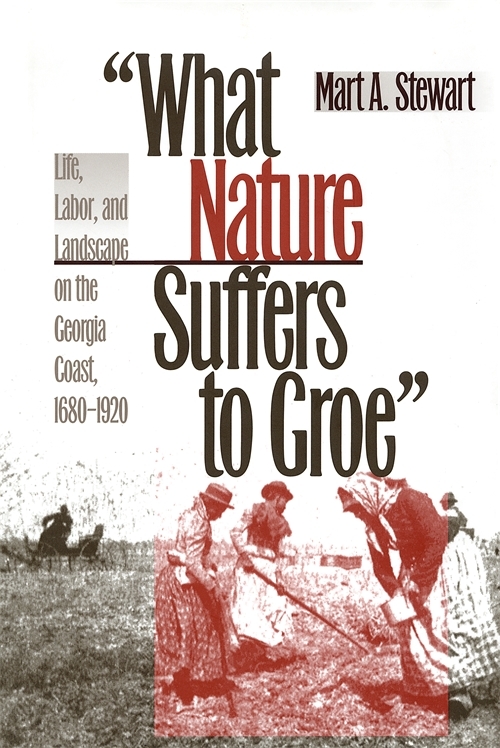
What Nature Suffers to Groe
Life, Labor, and Landscape on the Georgia Coast, 1680-1920
Title Details
Pages: 392
Illustrations: 42 b&w photos
Trim size: 6.120in x 9.250in
Formats
Paperback
Pub Date: 12/23/2002
ISBN: 9-780-8203-2459-3
List Price: $34.95
Subsidies and Partnerships
Published with the generous support of Wormsloe Foundation Publications
Related Subjects
HISTORY / United States / State & Local / South (AL, AR, FL, GA, KY, LA, MS, NC, SC, TN, VA, WV)
Other Links of Interest
• Learn more about Heaven Bound at the New Georgia Encyclopedia
What Nature Suffers to Groe
Life, Labor, and Landscape on the Georgia Coast, 1680-1920
Skip to
- Description
- Reviews
- Awards
"What Nature Suffers to Groe" explores the mutually transforming relationship between environment and human culture on the Georgia coastal plain between 1680 and 1920. Each of the successive communities on the coast—the philanthropic and imperialistic experiment of the Georgia Trustees, the plantation culture of rice and sea island cotton planters and their slaves, and the postbellum society of wage-earning freedmen, lumbermen, vacationing industrialists, truck farmers, river engineers, and New South promoters—developed unique relationships with the environment, which in turn created unique landscapes.
The core landscape of this long history was the plantation landscape, which persisted long after its economic foundation had begun to erode. The heart of this study examines the connection between power relations and different perceptions and uses of the environment by masters and slaves on lowcountry plantations—and how these differing habits of land use created different but interlocking landscapes.
Nature also has agency in this story; some landscapes worked and some did not. Mart A. Stewart argues that the creation of both individual and collective livelihoods was the consequence not only of economic and social interactions but also of changing environmental ones, and that even the best adaptations required constant negotiation between culture and nature. In response to a question of perennial interest to historians of the South, Stewart also argues that a "sense of place" grew out of these negotiations and that, at least on the coastal plain, the "South" as a place changed in meaning several times.
This is, in short and without exception, the best environmental history of an agricultural landscape that I have read. Mart A. Stewart has an eye not only for details of a place, but also for the complex web of interactions, natural and social, that go into its creation. He has so linked the social history of the peoples of coastal Georgia with their construction of the land that only the most obtuse historian would attempt to separate them again.
—Richard White, University of Washington
Scholars in disciplines from colonial studies to agricultural history to landscape studies will find it a stunning achievement . . . Sumptuously rich in detail woven by its author into many larger arguments that demonstrate the enduring power of place, and especially what ecologists call 'natural systems,' through gradual and traumatic social change.
—American Historical Review
Establishes Stewart's credentials as a leading authority on the history of the southern lowcountry and a leading practitioner of the craft of environmental history.
—Florida Historical Quarterly
The impressive way in which North American historians, following such luminaries as Donald Worster and Bill Cronon, have started to engage with the land is shown in this book. . . . There are two audiences for this book: the 'local', who will be fascinated by the detail of what exactly happened when and to whom, and the wider group, for whom the general conclusions fit into a wider construction of the main types of relationship between the material and the ideational. But as an example of detailed scholarship on what produced for various times a sense of place, this book will have an honourable place on the shelves of historians and of historical geographers whose interests extend beyond the purely social and political.
—ECUMENE
A pleasure to read . . . By bringing the techniques of environmental history to bear upon lowcountry Georgia, Mart Stewart has performed a valuable service.
—Slavery and Abolition
A nuanced and meticulously researched account . . . This is a landscape that has undergone extraordinary transformations and retransformations in the past 300 years. Mart Stewart has described and analyzed them with great skill and subtlety.
—Geographical Review
There is much to like in this volume. The prose is consistently enviable. The author's exposition of the intricate workings of the wet-rice plantations is deft as well.
—Journal of Southern History
A detailed and thoroughly readable case study of some important themes in a particularly appropriate local setting . . . Many more such books are needed.
—Southern Cultures
Winner
Malcolm Bell, Jr., and Muriel Barrow Bell Award, Georgia Historical Society