

Transforming Scriptures
African American Women Writers and the Bible
Title Details
Pages: 180
Trim size: 6.000in x 9.000in
Formats
Paperback
Pub Date: 05/01/2011
ISBN: 9-780-8203-3880-4
List Price: $34.95
Hardcover
Pub Date: 02/01/2010
ISBN: 9-780-8203-3090-7
List Price: $120.95
Related Subjects
Transforming Scriptures
African American Women Writers and the Bible
Skip to
- Description
- Reviews
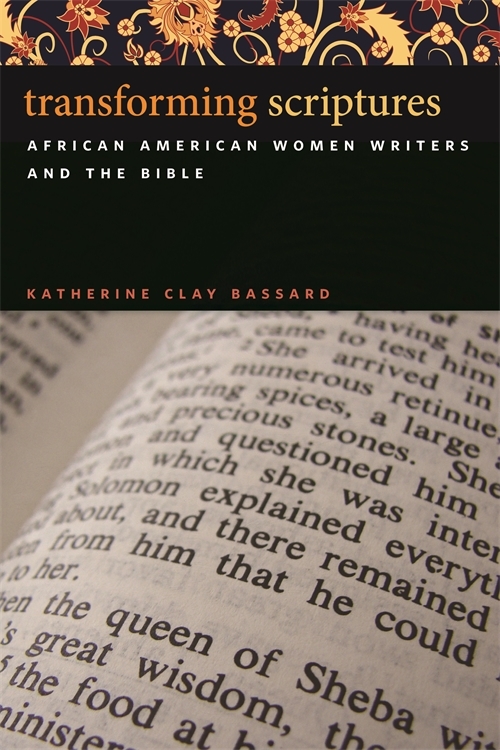
Transforming Scriptures is the first sustained treatment of African American women writers’ intellectual, even theological, engagements with the book Northrop Frye referred to as the “great code” of Western civilization. Katherine Clay Bassard looks at poetry, novels, speeches, sermons, and prayers by Maria W. Stewart, Frances Harper, Hannah Crafts, Harriet E. Wilson, Harriet Jacobs, Zora Neale Hurston, Toni Morrison, and Sherley Anne Williams and discusses how such texts respond as a collective “literary witness” to the use of the Bible for purposes of social domination. Black women’s historic encounters with the Bible were, indeed, transformational; in the process of “turning cursing into blessing” these women were both shaped and reshaped by the scriptures they appropriated for their own self-representation.
Two important biblical figures emerge as key tropes around which women fashioned a counternarrative to the dominant culture’s “curse” on black female identity: the “talking mule” from Numbers 22 and the “black but comely” Shulamite of Song of Songs, the Queen of Sheba. Transforming Scriptures analyzes these tropes within a range of contexts, from biblical justifications of slavery and the second-class status of women to hermeneutical and post-structural critiques of the Bible. African American women’s appropriations of scripture occur within a continuum of African American Bible-reading practices and religious or ideological commitments, argues Bassard. There is thus no single “black women’s hermeneutic”; rather, theories of African American women and the Bible must account for historical and social change and difference.
With a topic so large yet so important to understanding currents of American intellectual and social development, one is nearly paralyzed to attempt an analysis. Yet Professor Bassard possesses the knowledge and the confidence to speak strongly in her own voice. She provides readers the helpful organizing principle of a 'continuum of thought,' presented by way of well-researched and thoughtfully articulated arguments set forth in a series of compelling tropes. Her systematic treatment of nontraditional biblical studies scholarship with an ethnic studies engagement underscores an important point relevant to any ethnic or racial study by avoiding an essentialist trap or a universalizing inclusion. This work illustrates that our understanding of the Bible and its relationship to African American literature come from multiple perspectives in constantly evolving endeavors that offer opportunities for reflection and understanding.
—Kimberly Rae Connor, author of Imagining Grace: Liberating Theologies in the Slave Narrative Tradition
Katherine Clay Bassard's pathbreaking study opens up an unduly neglected but very important subject. Through close readings of many important works and close reasoning about what she has read, Bassard reveals the multiple, sometimes conflicting, but centrally important engagement of black women writers with the Christian Scriptures. This book should be welcomed by historians, literary scholars, students of religion, and a broad reading public.
—Mark A. Noll, author of God and Race in American Politics: A Short History
Transforming Scriptures is an important contribution to research on African American women and their writers’ voices and on the cross-cultural phenomenon of inventing and using scriptures. In the creative ways in which Bassard brings the two areas together she broadens and deepens and makes them more compelling. The book is illuminating, daring, and, perhaps, most important, suggests new areas of meaningful transdisciplinary research. I recommend it with enthusiasm.
—Vincent L. Wimbush, editor of Theorizing Scriptures: New Critical Orientations to a Cultural Phenomenon
In this brilliant, cogently argued book, Katherine Clay Bassard elegantly explores the ways in which an array of African American women writers from Frances E. W. Harper and Harriet Jacobs to Sherley Anne Williams and Toni Morrison have provided a collective 'literary witness' to respond to the use of the Bible for purposes of social domination. An astute literary critic, Biblical scholar, and feminist theorist, Bassard here interweaves diverse methodologies to produce a landmark and field-defining work of scholarship.
—Valerie Smith, Director, Center for African American Studies and Woodrow Wilson Professor of Literature, Princeton University
Bassard’s Transforming Scriptures will appeal to literary and social historians, to feminists and womanists of all academic disciplines and religious backgrounds, and especially to biblical scholars and theologians. Chiefly, Bassard sets out to demonstrate how nineteenth-century African American women, enslaved and freeborn, transformed the curses of white supremacist Christianity into divine blessings of love and autonomy.
—Joycelyn Moody, Signs