

South Carolina Women
Their Lives and Times, Volume 1
Title Details
Pages: 336
Illustrations: 14 b&w photos
Trim size: 6.000in x 9.000in
Formats
Hardcover
Pub Date: 05/25/2009
ISBN: 9-780-8203-2935-2
List Price: $120.95
Paperback
Pub Date: 05/25/2009
ISBN: 9-780-8203-2936-9
List Price: $34.95
eBook
Pub Date: 05/25/2009
ISBN: 9-780-8203-6795-8
List Price: $34.95
Related Subjects
HISTORY / United States / State & Local / South (AL, AR, FL, GA, KY, LA, MS, NC, SC, TN, VA, WV)
South Carolina Women
Their Lives and Times, Volume 1
Skip to
- Description
- Reviews
- Contributors
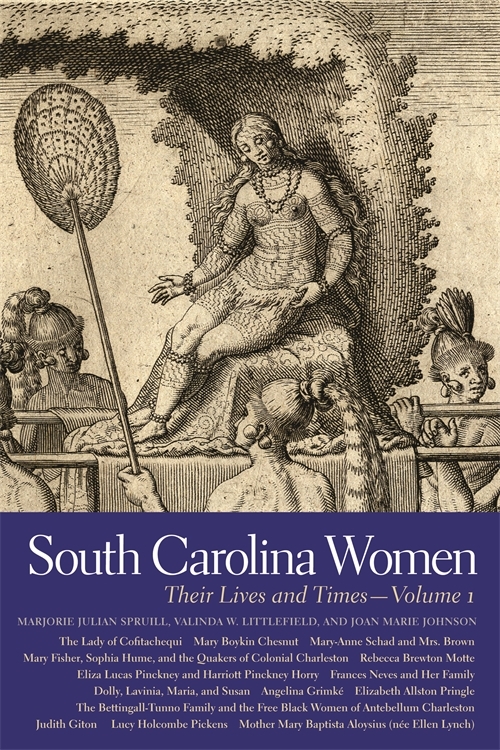
This volume, which spans the long period from the sixteenth century through the Civil War era, is remarkable for the religious, racial, ethnic, and class diversity of the women it features. Essays on plantation mistresses, overseers' wives, nonslaveholding women from the upcountry, slave women, and free black women in antebellum Charleston are certain to challenge notions about the slave South and about the significance of women to the state's economy. South Carolina's unusual history of religious tolerance is explored through the experiences of women of various faiths, and accounts of women from Europe, the West Indies, and other colonies reflect the diverse origins of the state's immigrants.
The volume begins with a profile of the Lady of Cofitachequi, who sat at the head of an Indian chiefdom and led her people in encounters with Spanish explorers. The essays that follow look at well-known women such as Eliza Lucas Pinckney, who managed several indigo plantations; the abolitionist Angelina Grimke; and Civil War diarist Mary Boykin Chesnut. Also included, however, are essays on the much-less-documented lives of poor white farming women (the Neves family of Mush Creek), free African American women (Margaret Bettingall and her daughters), and slave women, the latter based on interviews and their own letters. The essays in volume 1 demonstrate that many women in this most conservative of states, with its strong emphasis on traditional gender roles, carved out far richer public lives than historians have often attributed to antebellum southern women.
Historical figures included:The Lady of CofitachequiJudith Giton ManigaultMary FisherSophia HumeMary-Anne SchadMrs. BrownRebecca Brewton MotteEliza Lucas PinckneyHarriott Pinckney HorryEnslaved woman known as DollyEnslaved woman known as LaviniaEnslaved woman known as MariaEnslaved woman known as SusanWomen of the Bettingall-Tunno FamilyAngelina GrimkéElizabeth Allston PringleMother Mary Baptista AloysiusMary Boykin ChesnutFrances NevesLucy Holcombe Pickens
This first volume of South Carolina Women: Their Lives and Times is an important contribution to our understanding of the history and culture of the Palmetto State. It is a welcome addition to my South Carolina bookshelf.
—Walter Edgar, author of South Carolina: A History and editor of The South Carolina Encyclopedia
This collection of lively essays on South Carolina women demonstrates the enormous diversity of women's situations and experiences and the ways in which race, class, religion, and history complicate gender as a category of analysis. It is a welcome addition to women's history and the history of the South.
—Theda Perdue, Atlanta Distinguished Professor of Southern Culture, University of North Carolina
Fascinating insights into some of the women who helped shape South Carolina . . . Together the essays show a collage of the types of women who make up our history and their strong ties to family.
—Post and Courier
The real value of this text . . . lies in its inclusiveness.
—Journal of Southern History
Engagingly written across all of the chapters, this book is suitable for a wide audience. . . . [R]eaders will be fascinated by the compelling array of women who added to South Carolina’s social, political, and economic history.
—Jennifer A. Stollman, South Carolina Historical Magazine
Alexia Helsley
Bertrand Van Ruymbeke
Charles Joyner
Charles Wilbanks
Christina Snyder
Constance Schulz
Elisabeth Showalter Muhlenfeld
Emily West
Georganne Burton
Laura Sandy
Orville Vernon Burton
Randy J. Sparks
Sara Marie Eye
Nancy Stockton