

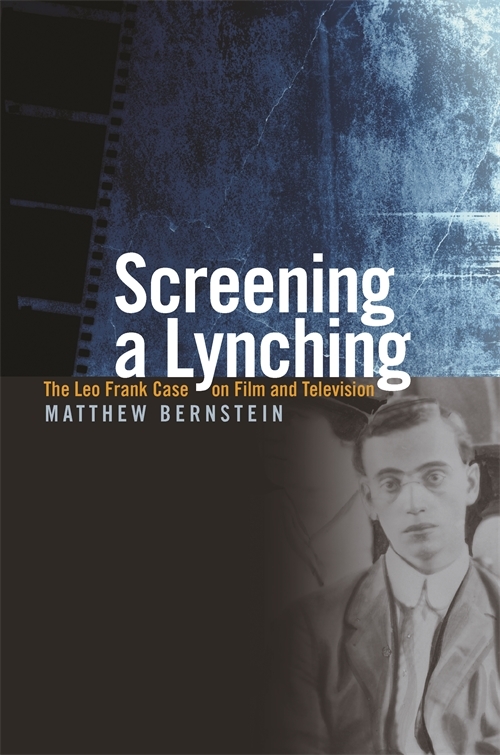
Screening a Lynching
The Leo Frank Case on Film and Television
Title Details
Pages: 352
Illustrations: 183 b&w photos
Trim size: 6.120in x 9.250in
Formats
Paperback
Pub Date: 02/15/2009
ISBN: 9-780-8203-3239-0
List Price: $34.95
Other Links of Interest
• Learn more about the Leo Frank case at the New Georgia Encyclopedia
Screening a Lynching
The Leo Frank Case on Film and Television
Skip to
- Description
- Reviews
- Awards
The Leo Frank case of 1913 was one of the most sensational trials of the early twentieth century, capturing international attention. Frank, a northern Jewish factory supervisor in Atlanta, was convicted for the murder of Mary Phagan, a young laborer native to the South, largely on the perjured testimony of an African American janitor. The trial was both a murder mystery and a courtroom drama marked by lurid sexual speculation and overt racism. The subsequent lynching of Frank in 1915 by an angry mob only made the story more irresistible to historians, playwrights, novelists, musicians, and filmmakers for decades to come.
Matthew H. Bernstein is the first scholar to examine the feature films and television programs produced in response to the trial and lynching of Leo Frank. He considers the four major surviving American texts: Oscar Micheaux's film Murder in Harlem (1936), Mervyn LeRoy's film They Won't Forget (1937), the Profiles in Courage television episode "John M. Slaton" (1964), and the two-part NBC miniseries The Murder of Mary Phagan (1988). Bernstein explains that complex issues like racism, anti-Semitism, class resentment, and sectionalism were at once irresistibly compelling and painfully difficult to portray in the mass media. Exploring the cultural and industrial contexts in which the works were produced, Bernstein considers how they succeeded or failed in representing the case's many facets. Film and television shows can provide worthy interpretations of history, Bernstein argues, even when they depart from the historical record.
Screening a Lynching is an engrossing meditation on how film and television represented a traumatic and tragic episode in American history-one that continues to fascinate people to this day.
Matthew Bernstein's Screening a Lynching is an impeccably researched and consistently enlightening inquiry into the media backfire from a notorious instance of a commonplace practice—the lynching in 1915 of the convicted rapist-murderer Leo Frank, a Jew from New York, by a mob of outraged Georgians. A marvelously synoptic work of cultural history that illuminates issues of race, ethnicity, religion, law, and cinematic representation (to name a few), Bernstein's penetrating study offers unique insights into a case that continues to haunt the American imagination.
—Thomas Doherty, author of Hollywood's Censor: Joseph I. Breen and the Production Code Administration
Screening a Lynching examines four Hollywood treatments of the infamous Leo Frank affair. Equally enlightening on the motivations of the producers and directors behind each project—two for film, two for TV—and the actual facts of the case, the book takes as its deeper concern the inherent tension between creative license and historical accuracy in reality-based dramas. This is a rich topic, and Bernstein handles it with aplomb.
—Steve Oney, author of And the Dead Shall Rise
Matthew Bernstein has written a detailed study of four very different mediums—two television shows, and two films—all based on the same actual murder case and its aftermath. Screening a Lynching is provocative, compelling and utterly original. I highly recommend it.
—Alfred Uhry, Pulitzer Prize winning author of Driving Miss Daisy
An amazingly original analysis of how this tragic case has been interpreted in fiction and film.
—Leonard Dinnerstein, author of The Leo Frank Case
Bernstein’s strong book effectively places these four films within their historical context. . . .[His] work is a valuable addition to a growing body of work on the Phagan-Frank case and its impact on American Culture.
—Kirsten Fermaglich, Journal of American Ethnic History
In this brilliant examination, [author Matthew H.] Bernstein examines the racist thread that kept open the case and its treatments in the media. . . . Searching through daunting but uncommonly rich archival material, the author tracked court cases bent on uncovering new evidence for pardoning Frank. As a Jew in 1913 he loomed as guilty, yet as a white man his case plead for reopening (in prior years Americans had, on average, lynched more than 100 victims, most of them black). This book deserves the widest possible audience.
—Choice
Winner
Outstanding Academic Title, Choice magazine
Runner-up
Richard Wall Memorial Award, Theatre Library Association