

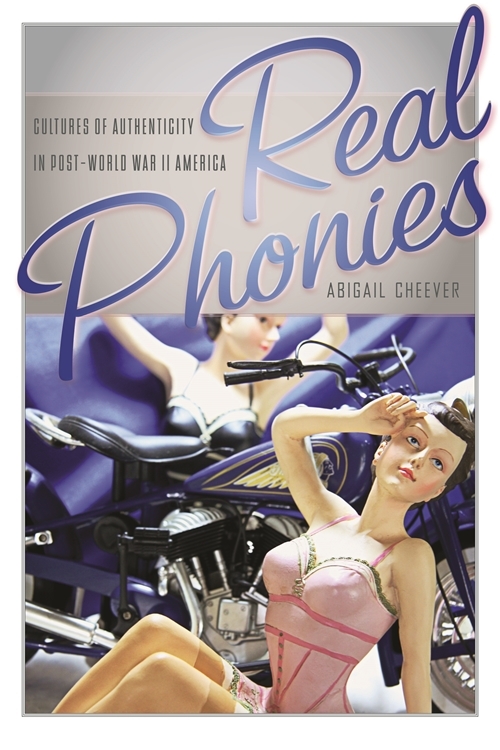
Real Phonies
Cultures of Authenticity in Post-World War II America
Title Details
Pages: 256
Illustrations: 23 photos
Trim size: 6.000in x 9.000in
Formats
Paperback
Pub Date: 02/01/2010
ISBN: 9-780-8203-3429-5
List Price: $27.95
Hardcover
Pub Date: 02/01/2010
ISBN: 9-780-8203-3283-3
List Price: $120.95
Real Phonies
Cultures of Authenticity in Post-World War II America
Skip to
- Description
- Reviews
The epithet “phony” was omnipresent during the postwar period in the United States. It was an easy appellation for individuals who appeared cynically to conform to codes of behavior for social approbation or advancement. Yet Holly Golightly “isn’t a phony because she’s a real phony,” says her agent in Breakfast at Tiffany’s. In exploring this remark, Abigail Cheever examines the ways in which social influence was thought to deform individuals in midcentury American culture. How could a person both be and not be herself at the same time? The answer lies in the period’s complicated attitude toward social influence. If being real means that one’s performative self is in line with one’s authentic self, to be a real phony is to lack an authentic self as a point of reference—to lack a self that is independent of the social world. According to Cheever, Holly Golightly “is like a phony in that her beliefs are perfectly in accordance with social norms, but she is real insofar as those beliefs are all she has.”
Real Phonies examines the twinned phenomena of phoniness and authenticity across the second half of the twentieth century—beginning with adolescents in the 1950s, like Holly Golightly and Holden Caulfield, and ending with mid-career professionals in the 1990s, like sports agent Jerry Maguire. Countering the critical assumption that, with the emergence of postmodernity, the ideal of “authentic self” disappeared, Cheever argues that concern with the authenticity of persons proliferated throughout the past half-century despite a significant ambiguity over what that self might look like.
Cheever’s analysis is structured around five key kinds of characters: adolescents, the insane, serial killers, and the figures of the assimilated Jew and the “company man.” In particular, she finds a preoccupation in these works not so much with faked conformity but with the frightening notion of real uniformity—the notion that Holly, and others like her, could each genuinely be the same as everyone else.
Abigail Cheever’s study of authenticity is an original and important contribution to the literary and cultural history of the postwar U.S. She provides elegant readings of a compelling array of texts and addresses the reader in a lucid and admirably restrained prose style.
—Catherine Jurca, author of White Diaspora: The Suburb and the Twentieth-Century American Novel
An innovative examination of the idea of authenticity and its significance to postwar American culture. Cheever reveals that what was cast as a concern with conformity was actually often a fear of uniformity, and her discerning critical eye finds that anxiety expressed in a surprising range of postwar genres—as prevalent in stories of serial killers and teenage loners as it was in tales of passing and corporate ambition. Her study gives us a new grasp on the contours of the postwar self.
—Sean McCann, author of A Pinnacle of Feeling: American Literature and Presidential Government
Real Phonies is an important addition to—and revision of—the literature on authenticity that has proliferated in the last thirty years. In a text that is both brilliant and accessible, Cheever changes the way we look at the American self in the second half of the twentieth century. Ranging through a landscape that includes Marjorie Morningstar and Silence of the Lambs, The Man in the Gray Flannel Suit and Prozac Nation, Cheever maps out a new theory of identity, while challenging us to think in fresh ways about texts and ideas we have long taken for granted.
—Laura Browder, Laura Browder, author of Her Best Shot: Women and Guns in America