

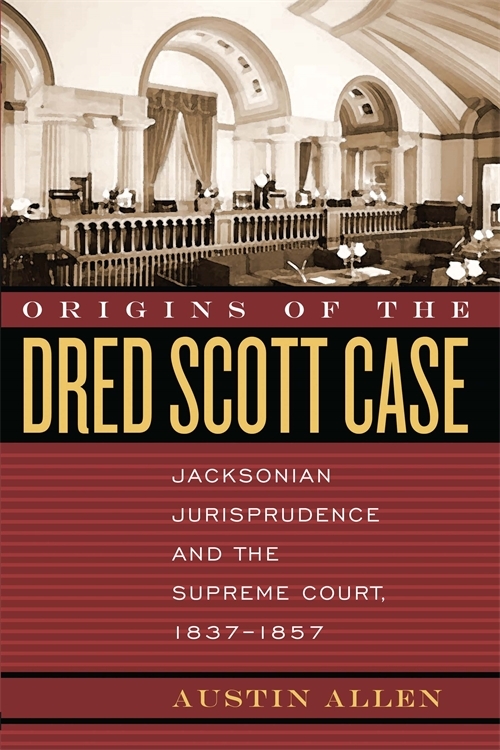
Origins of the Dred Scott Case
Jacksonian Jurisprudence and the Supreme Court, 1837-1857
Title Details
Pages: 288
Trim size: 6.000in x 9.000in
Formats
Paperback
Pub Date: 05/01/2006
ISBN: 9-780-8203-2842-3
List Price: $29.95
Related Subjects
Origins of the Dred Scott Case
Jacksonian Jurisprudence and the Supreme Court, 1837-1857
Skip to
- Description
- Reviews
The Supreme Court's 1857 Dred Scott decision denied citizenship to African Americans and enabled slavery's westward expansion. It has long stood as a grievous instance of justice perverted by sectional politics. Austin Allen finds that the outcome of Dred Scott hinged not on a single issue—slavery—but on a web of assumptions, agendas, and commitments held collectively and individually by Chief Justice Roger B. Taney and his colleagues.
Allen carefully tracks arguments made by Taney Court justices in more than 1,600 reported cases in the two decades prior to Dred Scott and in its immediate aftermath. By showing us the political, professional, ideological, and institutional contexts in which the Taney Court worked, Allen reveals that Dred Scott was not simply a victory for the Court's prosouthern faction. It was instead an outgrowth of Jacksonian jurisprudence, an intellectual system that charged the Court with protecting slavery, preserving both federal power and state sovereignty, promoting economic development, and securing the legal foundations of an emerging corporate order—all at the same time. Here is a wealth of new insight into the internal dynamics of the Taney Court and the origins of its most infamous decision.
In this original and provocative look at one of the most important judicial decisions in American history, Austin Allen skillfully re-creates the mid-nineteenth century Supreme Court's intellectual world. For the first time, Allen dissects the internal workings of Roger Taney's Court, showing how the justices constructed a logic parallel but separate from the political controversies that raged outside their Court. This book is indispensable for understanding the intricate connections between Jacksonian democracy, the Supreme Court, and the coming of the Civil War.
—Christopher Waldrep, author of The Many Faces of Judge Lynch
Austin Allen has written an absolutely superb, and original, book that is full of extraordinarily clearly presented insights about the various legal contexts within which the Dred Scott litigation occurred and was decided by the Supreme Court. Anyone interested in the development of American constitutional law and the role of the Supreme Court must read this book.
—Sanford Levinson, University of Texas School of Law
Austin Allen has found a new and intriguing angle on the infamous Dred Scott case. . . . He explains relatively technical and obscure elements of early nineteenth-century law in an accessible and clear fashion. . . . This book is essential reading for anyone interested in the Dred Scott case, and is quite valuable for anyone interested in the Supreme Court, law, and politics during the Jacksonian era.
—Civil War History
This brilliant volume is filled with insight across antebellum legal thought. . . . Everyone working in antebellum legal history needs to engage this book. We will all be grappling . . . with Allen's thoughtful, bold book for the rest of our careers. He has opened Dred Scott again to study and shown us that we have much to learn about the complex relationship of judicial doctrine and proslavery ideology.
—Register of the Kentucky Historical Society
Allen has written a fine book: instructive, perceptive, and well researched . . . [Origins of the Dred Scott Case] will not be the last word on the subject, but, from this point forward, it must be part of any intelligent discussion.
—American Historical Review
Allen's well-written book is a fine introduction to Jacksonian jurisprudence and the politics of the Taney court . . . original and informative.
—Journal of American History
Here is a wealth of new insight into the internal dynamics of the Taney Court and the origins of its most infamous decision
—McCormick Messenger
Makes important contributions this scholarship on sectional controversies in antebellum America.
—Law and History Review