

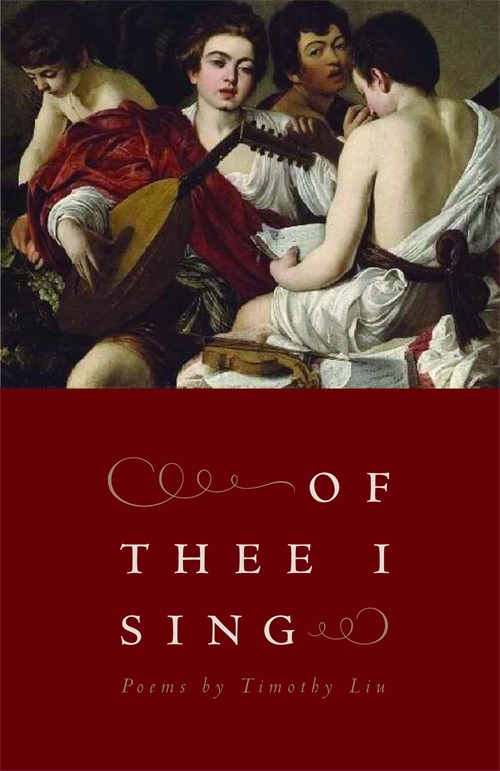
Of Thee I Sing
Poems
Title Details
Pages: 80
Trim size: 5.500in x 8.500in
Formats
Paperback
Pub Date: 03/08/2004
ISBN: 9-780-8203-2600-9
List Price: $20.95
Series
Related Subjects
Of Thee I Sing
Poems
Skip to
- Description
- Reviews
Timothy Liu writes out of an angry materialism, ill-fitting body, disappointment at every turn. He takes on his point of view wholeheartedly and compresses the consequences into phrases that echo and mimic each other, thereby increasing the sensation of claustrophobia and fever. Lots of humor erupts to keep the machine going. Is will the same as desire? It didn't used to be, but now it is. His poetry is fully present to the time we are in, and takes it on as a serious failure of intention.
—Fanny Howe, author of The Wedding Dress
With formidable invention, Tim Liu has made a book that is the 'flesh canoe' of liberty, American liberty. Family, sex, art, the fissures of liberty: 'America's / indigenous sublime.' By his eloquent, memorable, unappeased example, Liu enjoins us to do what Ginsberg did, put our queer shoulders to the wheel.
—Frank Bidart
The book’s greatest strength is Liu’s willingness to pick through American culture and his personal life while acknowledging that ‘Innocence means nothing / to us now.’ This stark vision, compelling him to wonder ‘So what if poetry / burns itself to the ground,’ has become as necessary as it is unsettling.
—Times Literary Supplement
[Liu's] poems provide plenty of reward . . . Liu's monostichs, full sentences as well as stark fragments, read like sound bites or news tickers at the bottom of a TV news screen. As such they seem prophetic.
—North American Review
Liu’s pointed imagery is rendered in meticulously metered verse, often in elegantly enjambed couplets or triplets or single end-stopped lines, with frequent references to art, music, and biblical or Greek mythology. His work evokes Rilke’s and Rodin’s contemplations of a fragmented, yet enduringly luminous and transformative sculpture of Apollo.
—Multicultural Review
Intense devotion to gay male desire collides with painful self-scrutiny, political protest and snapshots of far-flung America in Timothy Liu's Of Thee I Sing, forming a hyperreal nation of passion and distress 'sworn into a cult of moon-lit chinoiserie.'
—Publishers Weekly
Liu’s transformations are startling and original, with lush language and series of fragmentary images to illustrate the tensions between the divine, the political and the physical.
—Sacramento News & Review