

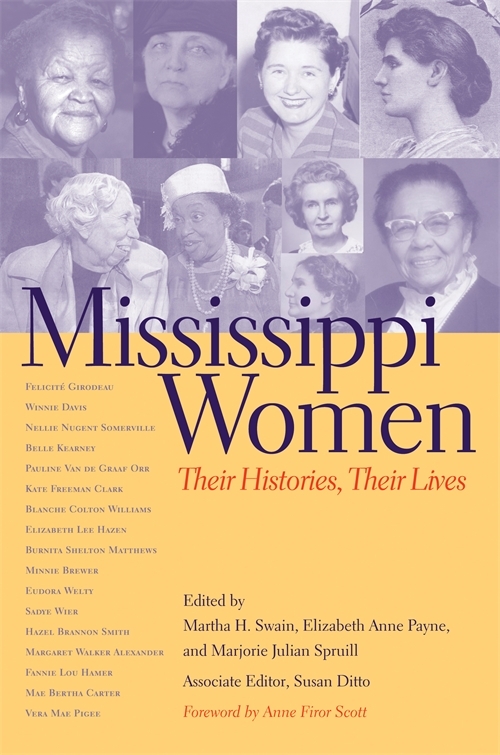
Mississippi Women
Their Histories, Their Lives, Volume 1
Title Details
Pages: 328
Illustrations: 16 b&w photos
Trim size: 6.000in x 9.000in
Formats
Hardcover
Pub Date: 11/17/2003
ISBN: 9-780-8203-2502-6
List Price: $120.95
Paperback
Pub Date: 11/17/2003
ISBN: 9-780-8203-2503-3
List Price: $34.95
Related Subjects
HISTORY / United States / State & Local / South (AL, AR, FL, GA, KY, LA, MS, NC, SC, TN, VA, WV)
Mississippi Women
Their Histories, Their Lives, Volume 1
Skip to
- Description
- Reviews
- Contributors
This collection of seventeen fascinating biographies, produced by the Mississippi Women's History Project, is an important step toward gaining the state's women their deserved place in its written record. The women whose absorbing life stories are told here range from Felicité Girodeau of old Natchez, who was both a person of color and a slaveholder, to Vera Mae Pigee, who "mothered" the civil rights movement in the Mississippi Delta. Some of the women are well known, others were prominent in their time but have since faded into obscurity, and a few have never received the attention they deserve.
Readers may already know such figures as writer and photographer Eudora Welty, civil rights activist Fannie Lou Hamer, and poet and educator Margaret Walker Alexander. Others are probably less familiar: the microbiologist Elizabeth Lee Hazen, the black businesswoman and civic leader Sadye Wier, the flapper feminist Minnie Brewer, or the jurist Burnita Shelton Matthews. All the featured women, whether suffrage pioneers, champions for higher education for women, or luminaries in art and literature, shared similar experiences in their struggles for success. From Winnie Davis, daughter of the Confederacy's president, to Hazel Brannon Smith, a journalist and antilynching crusader, they had in common the pains and privileges that were part of womanhood in their times.
As multifaceted as the state they helped to build, the women portrayed in this engaging volume will interest and inspire Mississippians of all ages. Scholars will find here a valuable resource that adds nuance and texture to southern and women's history.
—William F. Winter, former governor of Mississippi
David D. Carson
James Carson
Cita Cook
Constance Curry
Susan Ditto
Sarah Wilkerson Freeman
Kate Greene
Françoise N. Hamlin
Robert Harris
Joanne Hawks
Kathleen Jenkins
John F. Marszalek
Mark Newman
Bridget Pieschel
Linda Reed
Dorothy Shawhan
Emily Clark
Anne Scott