

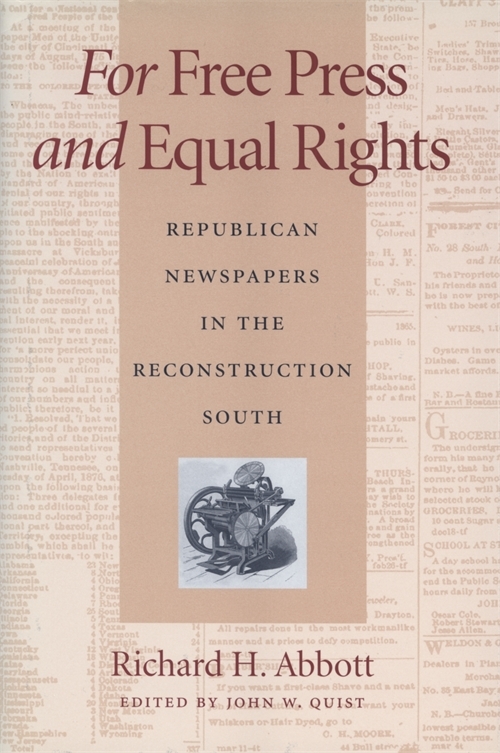
For Free Press and Equal Rights
Republican Newspapers in the Reconstruction South
Title Details
Pages: 264
Trim size: 6.000in x 9.000in
Formats
Hardcover
Pub Date: 01/30/2004
ISBN: 9-780-8203-2527-9
List Price: $50.95
Related Subjects
For Free Press and Equal Rights
Republican Newspapers in the Reconstruction South
Skip to
- Description
- Reviews
For Free Press and Equal Rights is an exhaustive study of the newspapers published in the Reconstruction South that had ties to the pro-Union, northern-based Republican party. Until now, no book has been devoted entirely to this subject. Richard H. Abbott's research draws on his readings from some 430 southern Republican papers. This figure accounts for literally hundreds more papers than are cited in the handful of previously published related studies—none of which makes more than passing reference to any of the topics that Abbott covers in detail.
Abbott first traces the origins of the southern Republican press from its lone stronghold in antebellum northwest Virginia to its wartime expansion in the wake of the Union Army's occupation of such far-flung places as Key West, Florida, and Port Royal, South Carolina. Abbott then discusses the challenges of establishing and sustaining a Republican press where the most likely readership—freed slaves—was usually illiterate and too poor to subscribe, much less to contribute advertising revenue. Looking at the different ways white and black editors faced common problems from ostracism and libel to vandalism and physical assault, Abbott also discusses the mixed blessings of patronage, by which Republican officials steered printing business to their party organs. Abbott's state-by-state, year-by-year analyses look at the fluctuating number of southern Republican papers in terms of their distribution in rural/urban and anti/pro-Republican areas.
For Free Press and Equal Rights reveals a wealth of information about papers ranging from the Visitor of Hot Springs, Arkansas, which lasted less than a year, to the Union Flag of Jonesborough, Tennessee, which ran from 1865 to 1873. It makes a number of new and important points about political patronage and the publishing process, race and print culture, Republican ideology and rhetoric, and our first amendment rights.
Richard Abbott's For Free Press and Equal Rights identifies an important niche in the era of Civil War and emancipation—that of the Republican press during Reconstruction. The research is excellent and original, by a historian with a lifetime's worth of knowledge in the field. No one has explored this important issue in such depth before. John Quist is to be congratulated for helping the late Professor Abbott's last project come to full fruition.
—Michael Fitzgerald, author of Urban Emancipation: Popular Politics in Reconstruction Mobile, 1860–1890
With its careful examination of southern Republican newspapers, For Free Press and Equal Rights sheds welcome new light on the volatile politics of the post-Civil War South. Abbott has given us a nuanced picture of the evolution of Republican policy as partisan editors tried to hold black readers while attracting whites. Abbott also uncovers the political imperative for the publishing contracts at the heart of postwar political corruption. Together, these important insights will prompt a new investigation of postwar southern politics.
—Heather Cox Richardson, author of The Death of Reconstruction: Race, Labor, and Politics in the Post-Civil War North, 1865–1901
Some of the most important historical monographs achieve their status not by pioneering conceptual innovation but by shedding light on previously neglected episodes or phenomena. A classic example is Robert S. Starobin's Industrial Slavery in the Old South. In For Free Press and Equal Rights, Richard H. Abbott does for Reconstruction-era Republican newspapers what Starobin did for industrial slavery. . . . Abbott has made a generous gift to historians. His Herculean research has filled in one of the final remaining lacunae in the history of Reconstruction. Moreover, he has portrayed with humanity an oft-overlooked group who nobly tried to bridge the post Civil War South's racial chasm.
—Chad Morgan, History: Reviews of New Books
Abbott's work is thorough and groundbreaking, and should inspire further examination of the Republican press in individual states and more studies of individual editors.
—Civil War History
Abbott addresses a neglected topic of Reconstruction history and adds to our understanding of southern Republicanism and journalism history.
—Carl R. Osthaus, Journal of American History
Thorough and readable . . . Those with an interest in nineteenth-century journalism can appreciate this comprehensive study regarding the Republican press in the South during Reconstruction. It establishes a sound historical context in which both white and black newspapers labored.
—Aleen J. Ratzlaff, American Journalism
[A] thorough and informative study . . . Abbott is nothing if not meticulous, often summarizing events state-by-state to suggest the full sweep of the Republican press's history in the postwarSouth. . . . A scholarly work of the first order . . . Abbott sheds new light on the critical role that the press played in this history. Moreover, his careful research in a long-neglected field makes this work invaluable for scholars interested in the political history of the Reconstruction era.
—Steve Tripp, Civil War Book Review
The late historian Richard H. Abbott has made a significant contribution in this study examining Republican newspapers in the Reconstruction South. Until now the topic has been almost entirely neglected. Abbot uncovers a far-ranging and significant, if ultimately doomed, regional newspaper press that attempted to spread Republican ideology and the newly formed party. . . . This is an extremely useful and well researched book.
—William Warren Rogers Jr., American Historical Review