

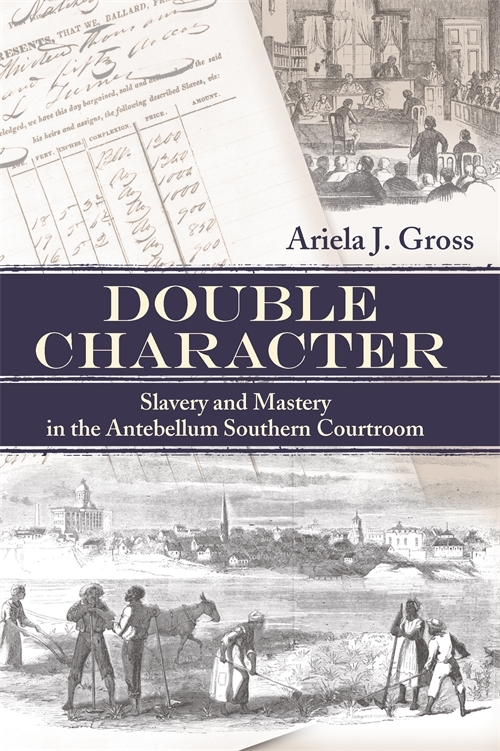
Double Character
Slavery and Mastery in the Antebellum Southern Courtroom
Title Details
Pages: 276
Illustrations: 17 b&w photos and illus.
Trim size: 6.000in x 9.000in
Formats
Paperback
Pub Date: 10/15/2006
ISBN: 9-780-8203-2860-7
List Price: $34.95
Related Subjects
Double Character
Slavery and Mastery in the Antebellum Southern Courtroom
Skip to
- Description
- Reviews
This groundbreaking study of the law and culture of slavery in the antebellum Deep South takes readers into local courtrooms where people settled their civil disputes over property. Buyers sued sellers for breach of warranty when they considered slaves to be physically or morally defective; owners sued supervisors who whipped or neglected slaves under their care.
How, asks Ariela J. Gross, did communities reconcile the dilemmas such trials raised concerning the character of slaves and masters? Although slaves could not testify in court, their character was unavoidably at issue—and so their moral agency intruded into the courtroom. In addition, says Gross, "wherever the argument that black character depended on management by a white man appeared, that white man's good character depended on the demonstration that bad black character had other sources."
This led, for example, to physicians testifying that pathologies, not any shortcomings of their master, drove slaves to became runaways. Gross teases out other threads of complexity woven into these trials: the ways that legal disputes were also affairs of honor between white men; how witnesses and litigants based their views of slaves' character on narratives available in the culture at large; and how law reflected and shaped racial ideology. Combining methods of cultural anthropology, quantitative social history, and critical race theory, Double Character brings to life the law as a dramatic ritual in people's daily lives, and advances critical historical debates about law, honor, and commerce in the American South.
Gross adds depth and complexity to our understanding of slavery's social and cultural framework, and of the tensions and contradictions slavery created in its American setting. . . . She provides valuable insight into the uses of paternalism as a perspective for understanding slavery and even into the professionalization of medicine, as it grew out of the requirements of southern slave law.
—American Historical Review
A fascinating journey inside slave trials of the antebellum Deep South . . . Gross weaves an intricate tale, and, unusually for some historians, her methodology is fully articulated on both the statistical and historiographical planes. . . . What will make this book even more interesting for social, intellectual, and cultural historians is Gross's ability to demystify what might normally be considered intricate and complicated about the law. . . . It is a pleasure to read a legal history that fuses hard statistical data to sophisticated intellectual and cultural history arguments, while maintaining the readability that allows non-lawyers access to the technical side of courtrooms.
—Reviews in American History
Gross moves the study of slave law beyond the traditional notion that the civil law of slavery concerned slaves only as property and not as people. Gross has successfully trawled local as well as state court records to find still another dimension of slave law.
—Journal of American History
Few scholars have demonstrated better that Gross that the law can provide a window into the cultural mores of another era. . . . Her study has helped to extend our understanding of social divisions among slaveholding and non-slaveholding whites, the white South's seemingly endless quest for vindication of honor, black and white gender roles, and the all important question of slavery and race in the antebellum South. . . . Double Character will prove invaluable to students in a number of areas. It not only provides a model of applying socio-legal research to legal history, but it also shows a mastery of contemporary research on slavery as well. It will prove to be of great value for students of legal history and the history of race relations in the United States.
—Southern Quarterly
A profoundly important book. At a time when there has been much romanticization of master-slave relations, Gross dissects hundreds of antebellum legal cases in which the presumed attributes of blacks, whites, and those 'in between' were litigated. What emerges is a pattern of assumptions whose power was sanctioned by law and whose legacy we battle still. A brilliant work of scholarship.
—Patricia Williams, Columbia School of Law
An exemplar of how detailed research and theoretical sophistication can be combined. Few writers are as at home as Gross with handling both large databases and complex cultural theories.
—The Historian
A nuanced and elegant interpretation of antebellum Southern law.
—Virginia Quarterly Review
With great clarity, Gross's book shows how intimately the practice of law in the antebellum U.S. South was interwoven with the practice of slavery. The author conveys this tragic story in terms that provide a vivid picture of that society and also of many of the individuals involved. She has successfully melded diverse approaches toward history—legal, local, social, political, economic, and cultural—while still maintaining a powerful central focus.
—Winthrop D. Jordan, University of Mississippi