

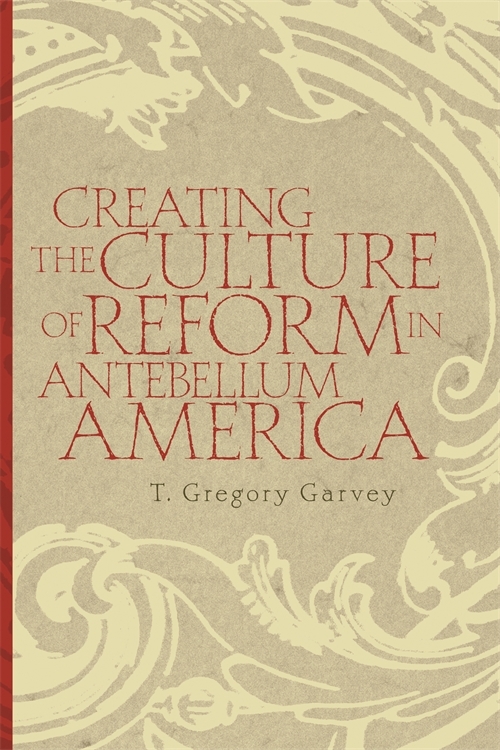
Creating the Culture of Reform in Antebellum America
Title Details
Pages: 280
Trim size: 6.000in x 9.000in
Formats
Paperback
Pub Date: 04/15/2010
ISBN: 9-780-8203-3519-3
List Price: $34.95
Creating the Culture of Reform in Antebellum America
Skip to
- Description
- Reviews
In this study, T. Gregory Garvey illustrates how activists and reformers claimed the instruments of mass media to create a freestanding culture of reform that enabled voices disfranchised by church or state to speak as equals in public debates over the nation’s values. Competition among antebellum reformers in religion, women’s rights, and antislavery institutionalized a structure of ideological debate that continues to define popular reform movements.
The foundations of the culture of reform lie, according to Garvey, in the reconstruction of publicity that coincided with the religious-sectarian struggles of the early nineteenth century. To counter challenges to their authority and to retain church members, both conservative and liberal religious factions developed instruments of reform propaganda (newspapers, conventions, circuit riders, revivals) that were adapted by an emerging class of professional secular reformers in the women’s rights and antislavery movements. Garvey argues that debate among the reformers created a mode of “critical conversation” through which reformers of all ideological persuasions collectively forged new conventions of public discourse as they struggled to shape public opinion.
Focusing on debates between Lyman Beecher and William Ellery Channing over religious doctrine, Angelina Grimke and Catharine Beecher over women’s participation in antislavery, and William Lloyd Garrison and Frederick Douglass over the ethics of political participation, Garvey argues that “crucible-like sites of public debate” emerged as the core of the culture of reform. To emphasize the redefinition of publicity provoked by antebellum reform movements, Garvey concludes the book with a chapter that presents Emersonian self-reliance as an effort to transform the partisan nature of reform discourse into a model of sincere public speech that affirms both self and community.
The fundamental argument of Creating the Culture of Reform in Antebellum America is significant and quite original. Garvey explores the nature of reform culture and public discourse in nineteenth-century America, basing his work on a very persuasive demonstration of the close connections between antebellum religious culture and the emerging culture of reform.
—David M. Robinson, author of Natural Life: Thoreau's Worldly Transcendentalism
Makes a significant contribution to the field of antebellum cultural studies in the perceptive way it links antislavery and women's rights to religious reform. It will be a good starting point for those interested in the broad and important subject of antebellum reform. Because the book is so clearly written, it will appeal to specialists and generalists alike.
—Robert S. Levine, author of Martin Delany, Frederick Douglass, and the Politics of Representative Identity
Garvey's work provides a refreshing look at religion and reform in antebellum America. . . . Garvey's contribution to the study of antebellum religion and reform is salient. This book provides historians with much-needed doses of literary and rhetorical theory while remaining grounded in important historical debates. Most importantly, it provides a more complete and nuanced context for understanding the origins and growth of antebellum reform culture as a whole.
—Southern Historian
Garvey's book reminds us that sometimes rhetoric is the reality, that inherited traditions of speech, debate, and persuasion can shape decisively the political culture of a given era. The author accordingly offers to readers across several disciplines a rich and compelling examination of four key debates in antebellum America. . . . This is a challenging, nuanced, and provocative book.
—American Historical Review