

A Consuming Fire
The Fall of the Confederacy in the Mind of the White Christian South
Title Details
Pages: 200
Trim size: 5.500in x 8.500in
Formats
Paperback
Pub Date: 03/01/2009
ISBN: 9-780-8203-3344-1
List Price: $25.95
Related Subjects
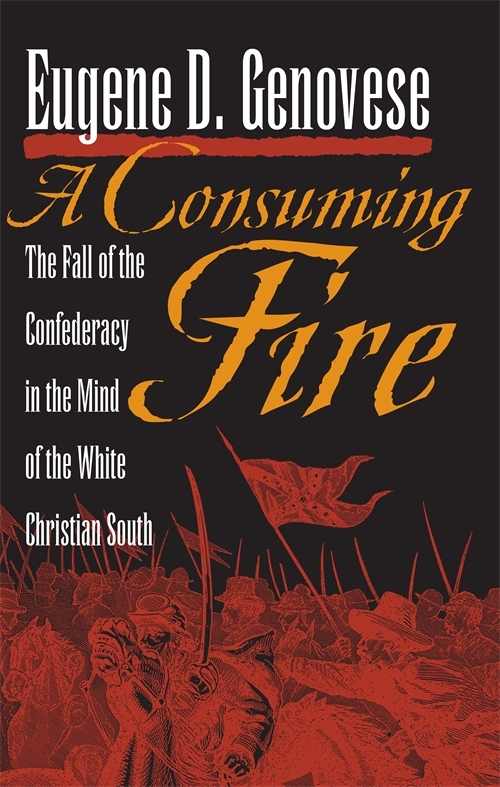
A Consuming Fire
The Fall of the Confederacy in the Mind of the White Christian South
Skip to
- Description
- Reviews
The fall of the Confederacy proved traumatic for a people who fought with the belief that God was on their side. Yet, as Eugene D. Genovese writes in A Consuming Fire, Southern Christians continued to trust in the Lord's will. The churches had long defended "southern rights" and insisted upon the divine sanction for slavery, but they also warned that God was testing His people, who must bring slavery up to biblical standards or face the wrath of an angry God.
In the eyes of proslavery theorists, clerical and lay, social relations and material conditions affected the extent and pace of the spread of the Gospel and men's preparation to receive it. For proslavery spokesmen, "Christian slavery" offered the South, indeed the world, the best hope for the vital work of preparation for the Kingdom, but they acknowledged that, from a Christian point of view, the slavery practiced in the South left much to be desired. For them, the struggle to reform, or rather transform, social relations was nothing less than a struggle to justify the trust God placed in them when He sanctioned slavery.
The reform campaign of prominent ministers and church laymen featured demands to secure slave marriages and family life, repeal the laws against slave literacy, and punish cruel masters. A Consuming Fire analyzes the strength, weakness, and failure of the struggle for reform and the nature and significance of southern Christian orthodoxy and its vision of a proper social order, class structure, and race relations.
A remarkable and important contribution to southern history during its most critical period . . . Written with intellectual rigor and impressive scholarship . . . [This] book belongs on the required reading list of all seriously interested in southern history.
—Civil War Book Review
Always a superb essayist, [Genovese] develops a crisp and powerful argument about the religious strand in the pro-slavery argument, before, during, and after the war.
—Times Literary Supplement
Thoroughly researched and cogently argued . . . Gives historians of the pro- and antislavery causes much to think about.
—American Historical Review
Genovese makes a convincing, well-documented case that, although southern ministers supported the war for a slaveholding republic, they did not do so uncritically and repeatedly warned southerners that they had to conform to God's word on the treatment of their slaves if the Confederacy were to benefit from God's support and achieve victory.
—Gaines M. Foster, Civil War History
Genovese has again essayed important questions that scholars need to address in more depth as they probe the many effects of the Civil War upon the South.
—Journal of Southern History
Tests the rhetoric of slave-holding as stewardship against a fearful reality many argued to reform. Both challenging and complementary to works by Drew Gilpin Faust, Mitchell Snay, and Jack P. Maddex, this book is characteristic Genovese--informative, insightful, and provocative.
—Library Journal
It should be viewed as a challenge to us all to try to understand the Old South in all its contradictory complexity, and especially to try to comprehend those southerners earnestly argued that slavery was a God-given trust.
—Southern Cultures
What seems most laudatory about Genovese is his attempt to try to see the white antebellum South in all its complexity and richness and to reaffirm the importance of religion in the region during the nineteenth century.
—H-CivWar