

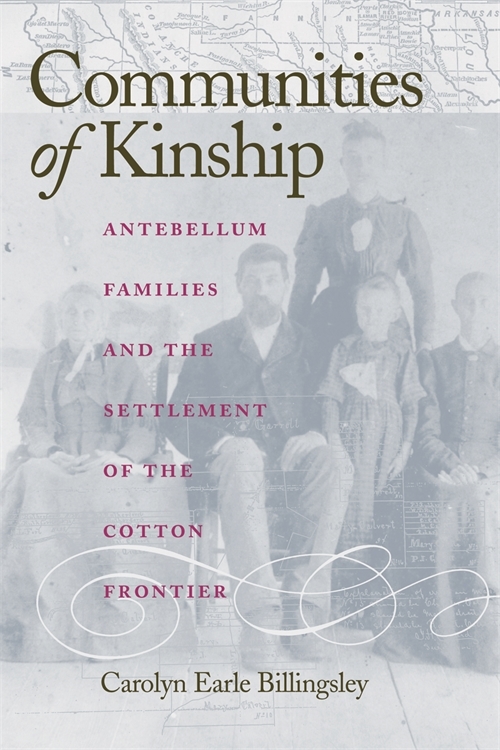
Communities of Kinship
Antebellum Families and the Settlement of the Cotton Frontier
Title Details
Pages: 232
Illustrations: 4 b&w photos, 2 figures
Trim size: 6.000in x 9.000in
Formats
Paperback
Pub Date: 08/31/2004
ISBN: 9-780-8203-2510-1
List Price: $30.95
Hardcover
Pub Date: 04/01/2017
ISBN: 9-780-8203-5222-0
List Price: $88.95
Related Subjects
Communities of Kinship
Antebellum Families and the Settlement of the Cotton Frontier
Skip to
- Description
- Reviews
- Awards
Trained as both a genealogist and a historian, Carolyn Earle Billingsley shows how the analytic category of kinship can add new dimensions to our understanding of the American South. In Communities of Kinship, she studies a southern family—-that of Thomas Keesee Sr.—-to show how the biological, legal, and fictive kinship ties between him and some seven thousand of his descendants and relatives helped to shape the growth of the interior South. Keesee, who was born in Pittsylvania County, Virginia, left there with his family when he was still a boy and subsequently lived in South Carolina, Tennessee, Alabama, and Arkansas.
Drawing on Keesee family history, Billingsley reminds us that, contrary to the accepted notion of rugged individuals heeding the proverbial call of the open spaces, kindred groups accounted for most of the migration to the South’s interior and boundary lands. In addition, she discusses how, for antebellum southerners, the religious affiliation of one’s parents was the most powerful predictor of one’s own spiritual leanings, with marriage being the strongest motivation to change them. Billingsley also looks at the connections between kinship and economic and political power, offering examples of how Keesee family members facilitated and consolidated their influence and wealth through kin ties.
Piecing together a wide assortment of public and private records that pertain to the Keesee family and shed light on naming practices, residential propinquity, migration patterns, economic and political dealings, and religious interactions, Billingsley offers a model of innovation and subtle analysis for historians. This important new study makes a persuasive case that kinship, particularly in the study of the antebellum South, should be considered a discrete category of analysis complementary to, and potentially as powerful as, race, class, and gender.
Blood ties, as historically invisible and intricately twisted as strands of DNA, have always been the building blocks of society. In Communities of Kinship, Billingsley maps one strand of the social genome that created the American South, demonstrating why historians will never truly understand society until they genealogically study the individual families who are the genes within the common body.
—Elizabeth Shown Mills, Samford University Institute of Genealogy and Historical Research
Billingsley's book accomplishes what previous studies of antebellum southern kinship stop short of doing by going beyond the borders of one community and state to examine how kinship and the process of migration shaped one another. Her focus on a single family and its thousands of descendants not only traces the role kinship played over an extended period of time and over an extended area, but also provides a valuable methodological bridge between genealogists and historians.
—Robert C. Kenzer, author of Kinship and Neighborhood in a Southern Community: Orange County, North Carolina, 1849-1881
In this fascinating work from start to finish, Billingsley presents her argument, expertly develops the theory, methodology, and evidence, and strongly supports the whole with the Keese family study. Communities of Kinship is for the scholar—historical or genealogical—who hopes, as the author does, that the book will become a 'starting point [for] an ongoing discussion of the place of kinship in historical inquiry.'
—National Genealogical Quarterly
This book is full of insights. Billingsley's rehabilitation of genealogical methods is as passionate as it is convincing.
—Florida Historical Quarterly
Convincingly argues that by combining the methodical approaches of each discipline to study kinship, historians can gain a better understanding of families and society.
—South Carolina Historical Magazine
Her case for the extensive character of the kinship connections and patterns that helped frame the lives of the white southerners is persuasive, as is her argument that serious genealogical work can effectively reveal connections and patterns likely to remain hidden in other kinds of historical research.
—Arkansas Historical Quarterly
Well written and carefully researched and organized, Communities of Kinship makes a strong case for the value of kinship studies to historical research.
—Lauren Ashley Laumen, East Texas Historical Association
The rigor of the research methodology is impressive. . . . She argues convincingly that genealogy offers some useful and underutilized tools for professional historians.
—Alabama Review
Winner
Booker Worthen Literary Prize, Central Arkansas Library System