

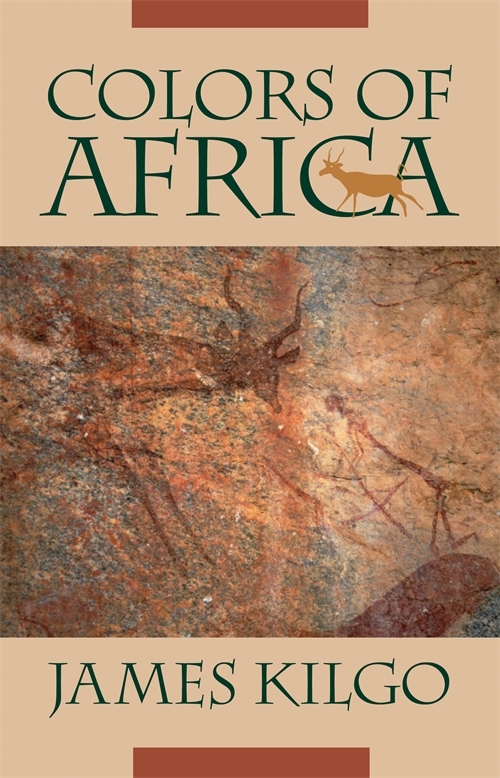
Colors of Africa
Title Details
Pages: 224
Trim size: 5.500in x 8.500in
Formats
Paperback
Pub Date: 09/01/2007
ISBN: 9-780-8203-3017-4
List Price: $26.95
Hardcover
Pub Date: 04/01/2017
ISBN: 9-780-8203-5219-0
List Price: $83.95
Series
Colors of Africa
Skip to
- Description
- Reviews
This extraordinary, candid account of James Kilgo's African sojourn conveys the untamed beauty of the bush country with the attention of a seasoned naturalist and the wonder of a first-time visitor. With startling immediacy Kilgo recalls what Zambia's Luangwa River valley revealed to him: its voices, scents, textures, and, most meaningfully, colors. Hues like sienna, ochre, and umber forged a visceral link between the people, animals, and landscapes Kilgo encountered and the muted palette of ancient rock paintings in caves and overhangs across southern Africa.
Kilgo barely knew the man who invited him to Africa. A further complication: the trip was a big-game safari, which conjured troubling images of privilege and excess. Yet he went, as an observer, for Africa had enthralled him since boyhood. Kilgo's recollections of his fellow travelers and the safari staff—their forays into the bush, visits to nearby villages, and long evening talks about nature, family, and faith—are all informed by a growing awareness of Africa's complexities and contradictions. As he reflects on the swirl of customs and beliefs all around him, as he and his traveling companions draw closer together, Kilgo measures what he has learned firsthand about Africa against his readings of those who came before him, including explorer and missionary David Livingstone, writers Ernest Hemingway and Isak Dinesen, and environmentalists Mark and Delia Owens.
Kilgo thinks often about hunting: about the days-long initiatory rites of local native hunters; the motivations, beyond money, that can drive a poacher; the carnage the animals visit on each other nightly just outside the walls of the idyllic safari compound. Near the end of his stay, he is offered the chance to hunt a kudu, the great antelope of storied elusiveness. Pondering this unexpected opportunity, Kilgo wonders: Has he connected sufficiently with this remarkable place to justify his participation in the hunt? Is he ready and, above all, is he worthy?
I can think of few authors so well qualified to write a book like this. James Kilgo, naturalist, spiritual thinker, hunter, historian, and, above all, author extraordinaire, has written something 'about' an African safari—but only in the way, say, that Melville wrote 'about' whaling. A splendid accomplishment.
—Sydney Lea, author of Hunting the Whole Way Home
Not everyone who visits Africa gets there in spirit. Bad Africa books abound, the detritus of ill-conceived travel. After reading this sharp-eyed, deeply felt, and clearly thought account of a safari to Zambia’s Luangwa River valley, I can see that not only did Jim Kilgo get to Africa; he was preparing to go all along. In Africa, he confronts in vivid, searching prose the tragic relation between man and nature embodied in the hunt and the many paradoxes of self and culture hunting reveals to us. He has a keen eye for the beauty of wildlife and landscape and a great appetite for the pleasures of being afield. Colors of Africa is not only a fine Africa book, it is a key to Jim Kilgo’s art and life. He has taken the skills honed on his home landscape in fiction and nonfiction and tested them in the revealing light of Africa, where what is universal in his voice comes through loud and clear.
—Christopher Camuto, author of Hunting from Home
Literature is filled with stories of what the dark continent does to men and women, from Conrad to Hemingway, from Gordimer to Dinesen. Kilgo was an eager follower in their footsteps, seeking reaffirmation of life, and perhaps redemption. . . . Though Kilgo has come along merely as a photographer, when he is given the opportunity to stalk the elusive Kudu deer, he wonders if he is up to the same challenge conquered by his literary forebear, Ernest Hemingway. Colors of Africa is more than a travelogue--it is part literary exploration, part personal journey. . . . James Kilgo, who died in December 2002, was an exceptional, starkly honest writer. This literate, moving, unsentimental book--his last--will take you to a world you may have only imagined.
—BookPage
Kilgo was an American hunter, writer, and professor with a lifelong curiosity about and interest in Africa that he was given an unexpected chance to satisfy near the end of his life. He seized the day, and eventually this chronicle was published posthumously. The knowledge of this timing gives the narrative an added poignancy in its reminder that in the midst of life, and especially the unique and glorious life of the hills and plains of Africa, we are near death, both the deaths of the hunted and sometimes also of the hunters. . . . Kilgo is well attuned to Africa's changes from the racist, colonial land it was, and he often writes with insight about the large African entourage of mixed 'blood' and mixed African and European heritage.
—North Dakota Quarterly
The book is a triumph, a literary travelogue obviously influenced by Dinesen, but with the likes of Hemingway, Conrad and David Livingstone also lighting the path.
—Creative Loafing (Atlanta)
In the tradition of hunter-authors Ernest Hemingway and Isak Dinesen, Kilgo followed his dreams to Africa and then wrote about the journey, a deeply spiritual quest that came at the end of his life.
—Covington News
Writers, the good ones, are lucky people. In life, they get to do this extraordinary thing, this writing. And in death, they leave behind these perfect, crystalline sentences, eternal insights into their thinking. The good ones do. . . . Throughout this memoir, Kilgo creates his distinctive sort of prose poetry, turning even an animal's death into something stunning.
—Teresa Weaver, Atlanta Journal Constitution
This spring, two of America’s most sophisticated travel writers . . . [have written] up their own recent journeys through Africa. . . . In contrast to Paul Theroux, who is constantly checking the measure of other people’s reaction to him, James Kilgo writes with such unfettered curiosity that it erases his presence and puts the reader in his shoes. Who wouldn’t want to be high-stepping through the bush, peering at magnificent birds and bulls, falling asleep at night to the cries of hyenas? OK, perhaps not everyone. But thanks to this book, we can be right there with him, while safely at home.
—John Freeman, Cleveland Plain Dealer