

Closer to the Truth Than Any Fact
Memoir, Memory, and Jim Crow
Title Details
Pages: 192
Trim size: 6.000in x 9.000in
Formats
Paperback
Pub Date: 04/01/2010
ISBN: 9-780-8203-3502-5
List Price: $17.95
Hardcover
Pub Date: 07/15/2008
ISBN: 9-780-8203-3069-3
List Price: $120.95
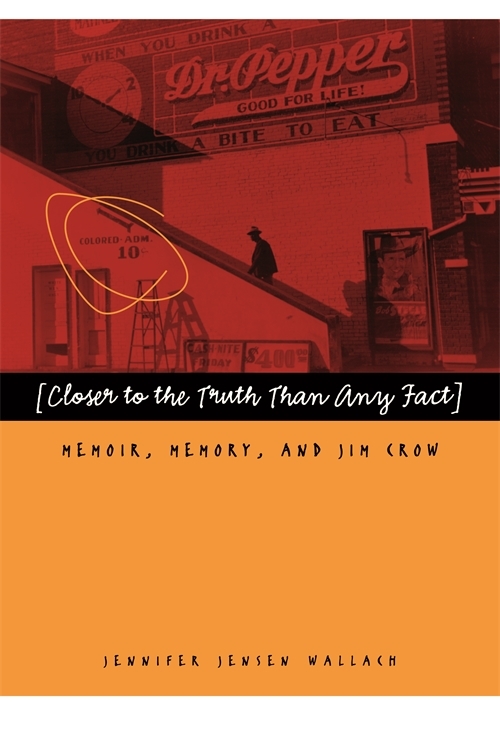
Closer to the Truth Than Any Fact
Memoir, Memory, and Jim Crow
Skip to
- Description
- Reviews
- Awards
Although historians frequently use memoirs as source material, too often they confine such usage to the anecdotal, and there is little methodological literature regarding the genre’s possibilities and limitations. This study articulates an approach to using memoirs as instruments of historical understanding. Jennifer Jensen Wallach applies these principles to a body of memoirs about life in the American South during Jim Crow segregation, including works by Zora Neale Hurston, Willie Morris, Lillian Smith, Henry Louis Gates Jr., William Alexander Percy, and Richard Wright.
Wallach argues that the field of autobiography studies, which is currently dominated by literary critics, needs a new theoretical framework that allows historians, too, to benefit from the interpretation of life writing. Her most provocative claim is that, due to the aesthetic power of literary language, skilled creative writers are uniquely positioned to capture the complexities of another time and another place. Through techniques such as metaphor and irony, memoirists collectively give their readers an empathetic understanding of life during the era of segregation. Although these reminiscences bear certain similarities, it becomes clear that the South as it was remembered by each is hardly the same place.
A quietly but uncommonly ambitious work . . . Wallach’s review of the theoretical literature on autobiography is refreshingly lucid and cogent. . . . I look forward to periodically rereading it and wrestling with its conclusions.
—W. Fitzhugh Brundage, Journal of American History
Wallach’s lucidly written essay offers much food for thought, both for scholars of history and life writing and for general readers trying to recapture the flavor of the past.
—Jeremy Popkin, Journal of Interdisciplinary History
Historians and particularly history students will find many valuable insights in this book. Wallach lays out a theoretical framework for understanding memoirs as source material and then does an excellent job of putting that theory into practice.
—Steve Estes, author of I am a Man: Race, Manhood, and the Civil Rights Movement
Wallach's interdisciplinary training allows her to demonstrate how attention to language, symbolism, allegory, and other literary devices can uncover more historically relevant content in a memoir than a mere surface reading would allow. This is a well-written and well-argued response to a single question: How should historians handle literary memoirs as historical sources?
—Jennifer Ritterhouse, author of Growing Up Jim Crow: How Black and White Southern Children Learned Race
Singularly sensitive, well argued, and closely attuned to the many manifestations of southern rage.
—Journal of Southern History
Winner
Outstanding Academic Title, Choice magazine