

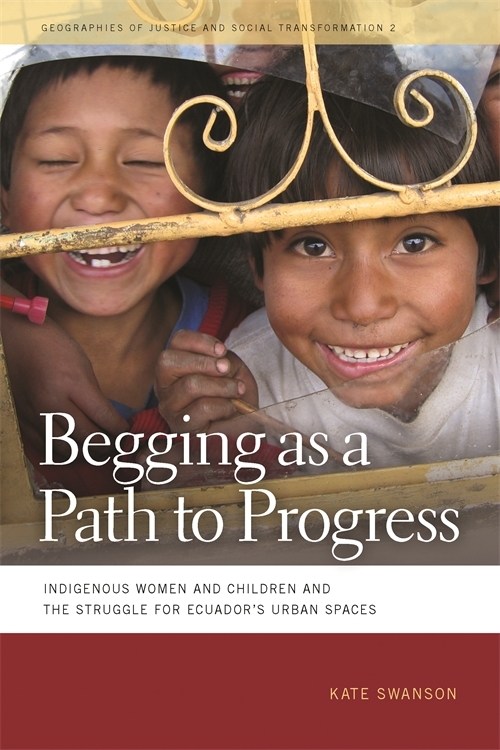
Begging as a Path to Progress
Indigenous Women and Children and the Struggle for Ecuador's Urban Spaces
Title Details
Pages: 152
Illustrations: 15 b&w photos
Trim size: 6.000in x 9.000in
Formats
Paperback
Pub Date: 03/01/2010
ISBN: 9-780-8203-3465-3
List Price: $30.95
Hardcover
Pub Date: 03/01/2010
ISBN: 9-780-8203-3180-5
List Price: $120.95
Begging as a Path to Progress
Indigenous Women and Children and the Struggle for Ecuador's Urban Spaces
Skip to
- Description
- Reviews
In 1992, Calhuasí, an isolated Andean town, got its first road. Newly connected to Ecuador’s large cities, Calhuasí experienced rapid social-spatial change, which Kate Swanson richly describes in Begging as a Path to Progress.
Based on nineteen months of fieldwork, Swanson’s study pays particular attention to the ideas and practices surrounding youth. While begging seems to be inconsistent with—or even an affront to—ideas about childhood in the developed world, Swanson demonstrates that the majority of income earned from begging goes toward funding Ecuadorian children’s educations in hopes of securing more prosperous futures.
Examining beggars’ organized migration networks, as well as the degree to which children can express agency and fulfill personal ambitions through begging, Swanson argues that Calhuasí’s beggars are capable of canny engagement with the forces of change. She also shows how frequent movement between rural and urban Ecuador has altered both, masculinizing the countryside and complicating the Ecuadorian conflation of whiteness and cities. Finally, her study unpacks ongoing conflicts over programs to “clean up” Quito and other major cities, noting that revanchist efforts have had multiple effects—spurring more dangerous transnational migration, for example, while also providing some women and children with tourist-friendly local spaces in which to sell a notion of Andean authenticity.
With an astute ethnographic eye, Kate Swanson rescripts begging as work, work that brings children and families to towns but provides means for their home villages to stay afloat, work that is embedded in kin networks whose sprawling geographies give new meaning to the notion of extended family, work whose received constructions suggest laziness and shame but which offers young people the autonomy to go to school and otherwise advance in their encounters with a rapidly globalizing economy. Reimagining the situated practices of begging and household reproduction strategies in Ecuador, Begging as a Path to Progress works across scale and locality to see the country in the city, the city in the country, and probe the differentiated consequences of global tourism and policies like ‘zero tolerance’ as they ricochet across national frontiers.
—Cindi Katz, author of Growing Up Global: Economic Restructuring and Children’s Everyday Lives
The 117 pages of text are an eye-opener to an aspect of society all too visible to the passerby but almost totally misunderstood by both locals and foreigners.
—Missiology
This is an extremely engaging book which challenges many assumptions that are taken for granted around begging, gender and childhoods in Ecuador. . . .Begging as a Path to Progress will not disappoint, for it pushes the reader to consider multiple perspectives and aspects of begging which unravel myths and reveal racist and sexist attitudes towards indigenous girls and young women in Ecuador.
—Samantha Punch, Journal of Latin American Studies
The 117 pages of text are an eye-opener to an aspect of society all to visible to the passerby but almost totally misunderstood by locals and foreigners.
—Missiology
Begging as a Path to Progress deserves a wide readership. Swanson offers a detailed account of the lives of women and children working as beggars in Quito. In the process, she overturns widely held stereotypes of street kids. The book also offers an off-beat perspective on indigenous issues.
—Ruth Colloredo-Mansfeld, Social and Cultural Geography
Swanson’s overall findings about what rural to urban migration is like for poor indigenous youth, especially women, how young women and children adapt to street work, and the vital role of work in providing a means for poor children to maintain school attendance are exceptional. This book is of particular interest to anyone seeking to understand better rural to urban migration in the global south or street labor as practiced by women and children.
—Thomas A. Offit, Journal of Latin American and Caribbean Anthropology
Swanson’s contribution to understanding indigenous peoples’ survival and urban uplift strategies should stand the test of time as a pioneering ethnographic work on the ethics and politics of Latin American charity.
—Chris Garces, Anthropos
This is a much needed study on the controversial issue of begging, covering gaps in several areas of scholarship. Swanson joins efforts with those advocating for the need to consider culturally diverse notions of childhood already acknowledged by academia, but rarely included in social policy design addressing children in the Global South.
—Patricia Oliart, Gender, Place & Culture