

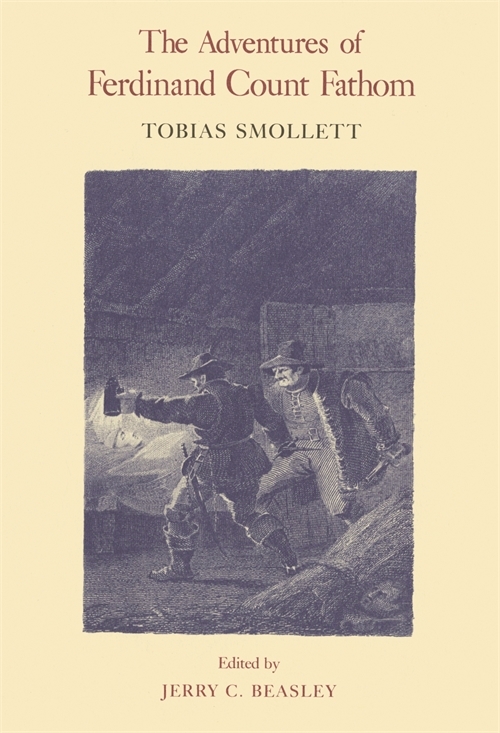
The Adventures of Ferdinand Count Fathom
Title Details
Pages: 528
Illustrations: 12 b&w illus.
Trim size: 6.000in x 9.000in
Formats
Paperback
Pub Date: 01/15/2014
ISBN: 9-780-8203-4601-4
List Price: $48.95
Hardcover
Pub Date: 08/01/1988
ISBN: 9-780-8203-1010-7
List Price: $120.95
Related Subjects
The Adventures of Ferdinand Count Fathom
Skip to
- Description
- Reviews
The first novel by a major English writer that is devoted to a thoroughgoing portrait of villainy, The Adventures of Ferdinand Count Fathom chronicles the life of an aberrant criminal character. Filled with striking satiric thrusts at the legal, medical, and military establishments of mid-eighteenth-century Europe and England, the novel reveals Tobias Smollett's capacities as a commentator on contemporary life.
First published in 1753, Ferdinand Count Fathom is an experimental work that explores the relations between history and fiction and introduces, for the first time in the English novel, episodes of Gothic melodrama. Too long neglected and never before available in a carefully prepared scholarly edition, Ferdinand Count Fathom may now be read, understood, and appreciated against the literary and historical background of the eighteenth-century world.
The appearance of the first volume of a major scholarly edition of the works of Tobias Smollett is an important event. . . . If the other editors of separate volumes in the series but match Beasley's work with Fathom, the whole project has been well worth the long wait. He has done a superb job. The introduction defines the place of this novel in Smollett's whole career. Also Beasley develops arguments that Fathom was a notable experiment in fiction, 'a serious and unblushing representation of remorseless (at least until the end) villainy,' and that the work represents an attempt to discover a way of presenting the relation between fiction and real life. Beasley's notes, more comprehensive than any ever offered before, are especially illuminating as identifications of literary allusions and historical references. No major research library can afford to pass over this volume. Indeed, all major libraries will want to subscribe to the entire edition. Most highly recommended.
—Choice
The appearance of Ferdinand Count Fathom is a cause for great celebration. . . . [Beasley’s] detailed and stylish introduction places this neglected novel (so clearly the ancestor of Thackeray’s Barry Lyndon) in the various contexts of Smollett’s career, the eighteenth-century literary scene, and the tradition of the novel. His textual notes are comprehensive, reliable, and exact. . . . It is impossible to imagine anything superseding it for many years to come.
—Eighteenth-Century Scotland
One of the major benefits of Beasley’s excellent edition of Fathom will be to make Smollett’s most experimental novel better known to eighteenth-century scholars, but also, thanks to its wealth of annotations, to convey to a wider public an intuitive sense of what is felt like to be living in mid-eighteenth century Britain.
—Studies in Scottish Literature